

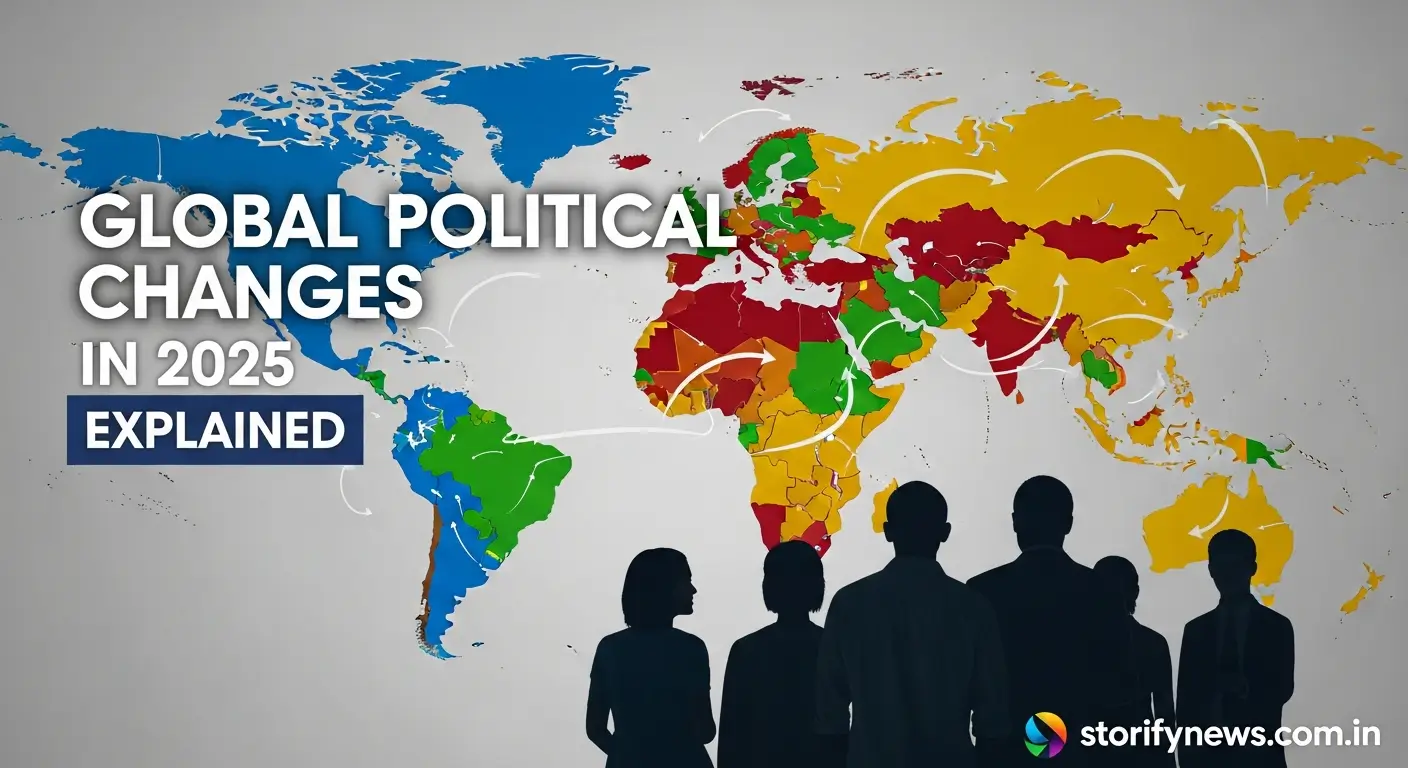
Period of 2025 has become one of the biggest milestones in the contemporary politics of the world, a discernible shift in the world power balance. To begin with, since the conclusion of the Cold War, several spheres are redefining their strategic interests, shaking their old alliances, and establishing a new multipolar equilibrium of power. Such world politics in 2025 is not merely about governments or diplomacy; it is more of a shift in the way economic power, technology, and government can change international relations.
The transition of world politics from the model of one dominant superpower to a model where multiple states, which are very powerful, including the United States, China, the European Union, India, and Russia, compete to assume regional and global leadership, is one of the most defining features of world politics in 2025. This is a reorganization that is being catalyzed by the fast-moving technological change, supply chain realignments, energy politics, and the new geopolitical competitions.
These two political developments across the globe will be required knowledge for anyone learning world politics, economics, or security patterns in the year 2025. These changes have already impacted third world countries, commercial affairs, global organizations, and even ordinary people. This paper defines the major forces behind these changes, and how they are altering the world order, and what this could spell out for the future of global governance beyond 2025.
Why 2025 Will Be a Great Breaking Point of Global Politics.
The year 2025 is relatively regarded as a pivotal moment in history since it is the year in which the post-Cold War political system that is characterized by one superpower, ends, and the phase of a more competitive and disintegrated world order starts. This is not like in the past decade, where the United States had the lead hand in international affairs, whereas there are now several states controlling the world. In military alliances to energy policies, and foreign policies, almost all regions have started rebranding their political positions.
The increased role of technology in politics that is accelerating is another fundamental cause of 2025 being considered a turning point. The old means of influence have been substituted by the use of artificial intelligence, cyber warfare, digital surveillance, and data-driven policymaking. Countries are currently resorting to technology platforms to compete for power, manage narratives, maintain supply chains, and redefine ideological balances. Technological innovation has become the key to the international political system instead of military power or economic dimensions alone.
2025 is also associated with a rising set of global crises that require political restructuring – climate pressure, resource shortages, migrant flows, economic turmoil, and weak systems of governance. Such multifaceted issues have compelled nation states to redefine alliances and national interests. To analysts and policymakers, it is important to comprehend the nature of 2025 as a turning point because it would lay the groundwork for the manner in which power would work in the rest of the decade.
Global Power Shifts and the Rise of a Multipolar World Order in 2025
The next most notable feature in global politics in 2025 is that the world will be multipolar, with power held by several powerful countries rather than being monopolized by a single country. The United States is still powerful, although it can no longer reign supreme. China is increasing its economic presence by the means of trade and technology, whereas India is becoming a strategic powerhouse in Asia.
Europe has also begun demanding to be an actor on its own in the world and not be dependent on transatlantic associations only. Such decentralization of power has brought new competition in the aspects of diplomacy, trade, and security cooperation. States are no longer making long-term ideological alliances but issue-based ones.
The transition to multipolarity also implies that weaker and emerging countries will have increased bargaining power. They no longer have to be subjected to binary alignments but can be able to bargain with various powers to achieve superior strategic and economic advantages. Due to this, international relations would be more fluid, transactional, and interest-driven in 2025. The shift to multipolarity as opposed to being unipolar is the crucible of the entire world politics of modern times.
US–China Rivalry and Its Influence on Global Political Changes in 2025
The United States versus China rivalry is the most significant factor of geopolitical change in 2025. They no longer compete in the sphere of trade; they compete now in technology, AI management, cybersecurity, supply chain, energy transition, and regional power. The competition of great powers that is going on today is not ideological and military as the Cold War was. The new frontier has been assurance of control over semiconductors, telecommunications, sea routes, rare minerals, and digital platforms.
This competition has made it necessary to re-evaluate the diplomatic policies of other nations. Most countries are not willing to side, hence they negotiate on a relationship factor of national interest. States in Southeast Asia, such as those in the Philippines, value China to act as their trade partners, but they turn to the U.S. as their security partners. The Middle East collaborates with the U.S. in the military arena but looks to China in terms of infrastructure and funding. Africa deals with technology alliances with both powers through competition to give better deals.
The place of alliances has also been altered in the US-China rivalry. Washington is enhancing military collaboration through the presence of AUKUS, QUAD, and NATO build-up, whereas Beijing is enlarging soft-power diplomacy through the Belt and Road initiatives as well as strategic investments. It is the interactions between these two giants that determine the global politics in 2025.
Europe’s Strategic Repositioning and Political Realignments in 2025
Europe 2025 is experiencing significant strategic change as it tries to target its place in world politics. European leaders, who have previously embraced U.S.-dominated security institutions, are currently advocating strategic autonomy, or independent foreign and defense policy, which will make them less reliant on the will of the great powers. The shift of geopolitical realities, including the regional aggressiveness of Russia, the economic role of China, and the ambiguity of the U.S., makes this repositioning a major factor.
European domestic politics is also changing. The European Union is making more investments in defense and sovereignty in technology, cybersecurity, and energy. As the world goes green, European states are in a battle to attain resources and supply chains, as well as to minimize exposure to external forces.
Moreover, Europe is taking a more balanced diplomatic role in international politics. It is becoming a regulatory superpower, rather than just aligning itself with Washington or Beijing, which means establishing global standards in technology, transparency in trade, and global climate governance. The repositioning of Europe in 2025 reflects the general historical trend in world politics: power is no longer exclusive to military strength but also to the ability to make rules, economic power, and normative power.
- Vicky Jain Business Complete Guide to Ventures, Success, and Growth Strategies
- Gaurav Khanna Net Worth 2025: Salary, Income, Assets & Wealth Details
- Rajat Sharma Net Worth 2025: Complete Wealth, Salary & Assets Breakdown
- Harshad Mehta Net Worth 2025: Complete Wealth, Assets & Biography
- Garima Singh News Anchor: Biography, Career, Achievements, and Influence
How Technological Advancements and AI Are Reshaping Global Politics in 2025
Technology has become a central driver of geopolitical power in 2025, replacing traditional military dominance as the primary strategic tool. Nations today compete through digital infrastructure, cybersecurity networks, AI capabilities, and control of data, which is often referred to as the “new oil” of the global economy. Artificial intelligence is transforming diplomacy, military systems, intelligence gathering, and economic regulation. As a result, national strength is increasingly measured by technological innovation rather than territory or population size alone.
AI is also reshaping political governance and election landscapes. Governments are using advanced data analytics to manage public sentiment, predict security threats, and enhance state surveillance. At the same time, political manipulation through social media, deepfakes, and algorithmic influence campaigns has blurred the line between information and propaganda. This new tech-driven environment has created a unique challenge for democracies, which must balance civil liberties with security concerns.
Furthermore, countries leading in AI development–such as the United States, China, and members of the European Union–are attempting to set global rules and ethical standards. This regulatory competition has deep political consequences because whoever controls standards controls access to emerging markets and technological ecosystems. Thus, technological advancements are not just improving capabilities; they are redrawing the global political map.
Economic Power Politics: Trade Wars, Sanctions, and Resource Competition
In 2025, global politics is increasingly driven by economic coercion rather than military confrontation. Trade wars, strategic tariffs, and sanctions have become tools of geopolitical pressure. Powerful states use financial systems and trade regulations to influence the behavior of rivals and realign global supply chains. Trade is no longer just commerce–it is a form of political leverage. By weaponizing market access and infrastructure investments, nations are reshaping alliances and dependency networks.
Resource competition has also intensified as the world transitions toward green energy and digital technologies. Lithium, cobalt, rare earth minerals, and semiconductor supply chains are now considered national security assets. Countries rich in these critical resources, including those in Africa, Latin America, and Central Asia, have gained new bargaining power in global negotiations. Control over resources determines which states will dominate technologically in the coming decades.
Sanctions and financial restrictions have emerged as the “new battlefield” of state rivalry. Instead of military invasions, powerful nations now restrict capital flows, banking access, or high-tech exports to weaken competitors. This shift has turned global politics into an economic chessboard where strategic partnerships are formed based on market interests and technological dependencies. The economic dimension of politics in 2025 proves that power projection is no longer only military–it is financial, digital, and resource-based.
Impact of Global Political Changes in 2025 on Developing Nations
Developing nations are experiencing both opportunities and vulnerabilities as global political dynamics shift in 2025. On one hand, multipolarity allows them to negotiate better deals by not depending on a single world power. Nations in Africa, South Asia, and Latin America can attract investments from multiple sources while retaining more autonomy in shaping local policies. This flexibility creates new economic and diplomatic options that were not available during the unipolar era.
However, developing countries also face new risks. Global competition among superpowers often turns them into strategic battlegrounds for influence. Debt dependency, military partnerships, infrastructure projects, and digital governance agreements may limit long-term sovereignty. Many poorer states struggle to balance Western institutions with Chinese investments or US-led security frameworks while protecting their domestic stability.
Another major impact is technological inequality. Wealthy nations are advancing with AI, automation, and digital regulation, while most developing nations lack the infrastructure to compete in this new political economy. This “tech divide” may create a new hierarchy between data-rich and data-poor nations. As a result, the geopolitical shifts of 2025 are reshaping not only power balances among superpowers but also development trajectories for billions of people.
Future Predictions: What Global Politics Could Look Like After 2025
Looking beyond 2025, the world is likely to move deeper into a competition-based geopolitical environment rather than a cooperative one. Power will continue to be distributed among multiple major actors, making global governance more fragmented. International institutions will lose influence unless they reform to reflect new power realities. Diplomatic blocs may become more flexible and transactional, shaped by short-term interest rather than ideology.
Artificial intelligence, biotechnology, and energy transitions will continue to define strategic competition. The next phase of geopolitics may focus on cyber dominance, digital currency wars, and control of advanced infrastructure. Countries that fail to adapt to technological transformation may face political marginalization. Meanwhile, middle powers like India, Turkiye, Brazil, and Indonesia will emerge as balancing forces between rival blocs.
Future conflicts may not look like traditional wars but rather economic blockades, cyberattacks, supply-chain control, or information warfare. By 2030, the world could see new global alliances built around climate security, water resources, and technological sovereignty. The political changes of 2025 are therefore not an isolated event; they are the beginning of a long-term reordering of world power that will reshape governance and diplomacy for the rest of the decade.
Frequently Asked Questions
What are the major global political changes in 2025?
In 2025, power is shifting from a single superpower system to a multipolar world. Regional alliances, tech governance, and economic rivalry now shape global politics.
Why is 2025 considered a turning point in global politics?
Because 2025 marks the moment when multiple countries gained strategic influence, challenging U.S. dominance. It is the start of a new world order.
How is AI affecting global politics in 2025?
AI is now used for governance, surveillance, foreign policy, and cybersecurity. Countries leading in AI gain diplomatic and economic power.
How does the US–China rivalry impact developing nations?
It gives developing countries more bargaining power, but also increases dependency risks. They must balance investment with political neutrality.
Which regions are gaining influence after 2025?
Asia, Africa, and parts of the Middle East are rising due to resources and demographics. Europe is growing as a regulatory and tech standards power.
What will global politics look like after 2025?
The future will remain multipolar, tech-driven, and economically competitive. Conflicts will move from military fronts to cyber, trade, and data arenas.
Conclusion
The international political development of 2025 is the start of a new phase of international relations, with the power spread out among various powerful countries rather than concentrated in the hands of one superpower. This movement towards multipolarity is changing the face of diplomacy, alliance-making, security policy, and technological rivalry. In contrast to the previous decades, when traditional geopolitics dominated the market, the new characteristics of the modern power are AI leadership, digital governance, economic leverage, and dominance over significant resources.
The development of countries is also taking a larger bargaining ground in international decision-making as the major powers such as the United States, China, the European Union, India, and Russia vie to control the situation. Meanwhile, these changes introduce fresh weaknesses in terms of trade dependencies, technological disparity, and cyber threats. Global bodies like the UN and WTO are also being pressurized to change since they find it hard to mirror a new power balance that defines the global world order.
To have a glimpse into the future, the politicization of 2025 is not a short run trend but the platform of a long run realignment of the world. Conflicts in the future are likely to be centered on data control, technology standards, pipelines, critical minerals, and digital sovereignty as opposed to warfare in the traditional format. This is vital in understanding how nations will compete, cooperate, and govern in the next decade due to these global political changes in 2025.
