

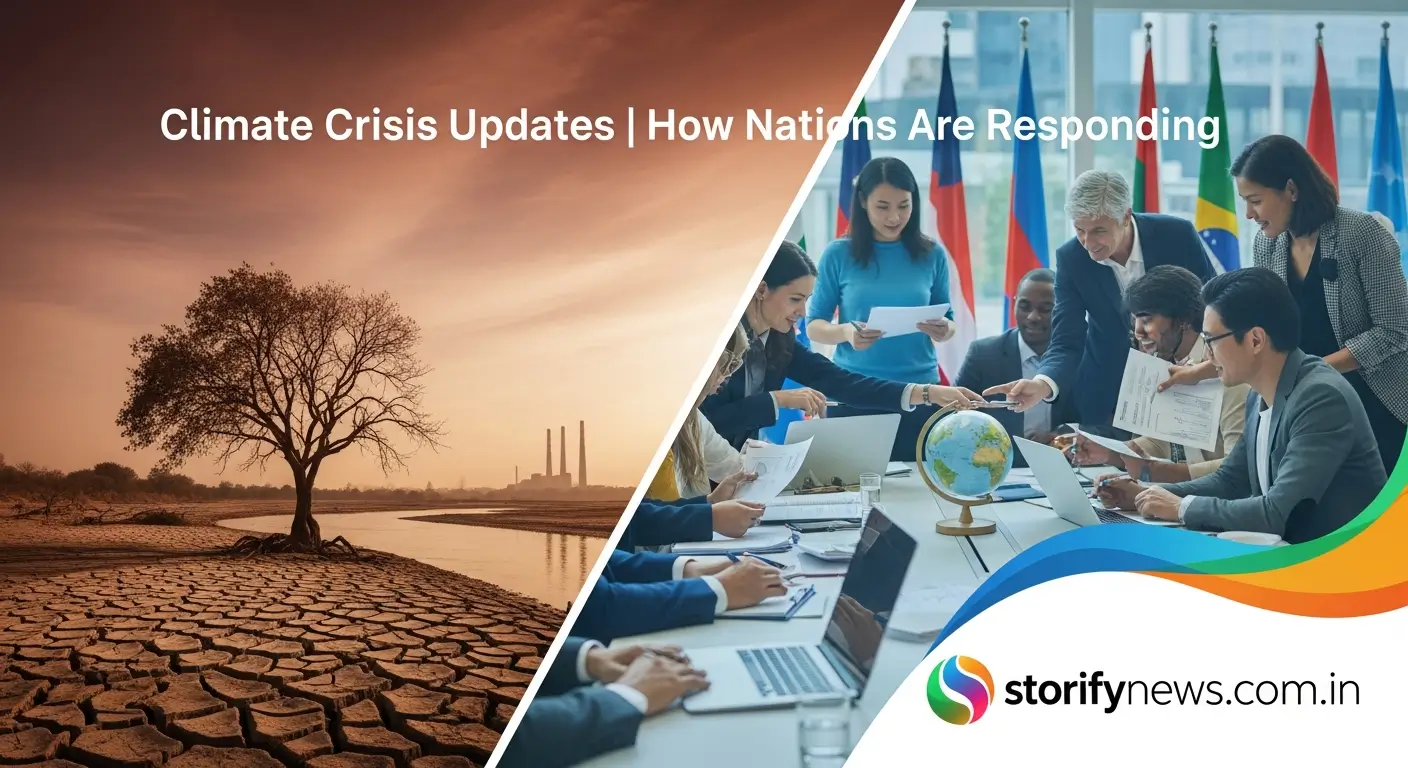
Climate crisis is the term that deals with the increasing rates of change in the global weather patterns due to human-induced greenhouse gas emissions. In contrast to the previous decades when climate change was a far-off issue, currently, it manifests itself in extreme temperatures, increasing water levels, floods, and disrupted ecosystems. Scientists have now termed it a crisis since the effects have transcended past slow environmental change and are currently defining economies, livelihood, and even human existence in real time. The current average global temperature has already increased by over 1.2 °C over the past century above pre-industrial levels, leaving the world in a very dangerous situation of close to 11.5 °Cof the levels, which is described as a red line by global agreements.
The nature of the climate crisis, which is a unique crisis, is that the impacts are not isolated, international, and increasing in pace. Climate effects, unlike local environmental issues, are not confined to boundaries; a drought in one country can cause food exports in a different country, and storms in a coastal area can cause migration that considerably alters the culture of whole societies. This implies that no state can be in a position to resolve the problem by itself. To do this effectively, coordination, cooperation, and long-term consistent policies that comply with global scientific goals are needed.
This paper will discuss the way different countries are addressing this challenge in terms of governance, financial instruments, technology transfer, adaptation plans, and emission-cutting plans. Some countries are developing rapidly, there are are developing at a slow pace due to economic or political pressures, and most of the developing countries are caught between the need to survive and the need to manage the climate. The key to assessing the advancement of climate in the world is to understand these differences and what is yet to be done.
The Current State of the Climate Crisis
Today, the situation in the climate is more serious than at any other time in human history. The world keeps increasing its carbon emissions despite the international climate promises made severally. The records are being made each year, the hottest year that ever existed, the most intense storms, and the worst wildfires. According to scientific evidence by the UN and leading climate research centers, the world is still not tracking to limit warming to 1.5degC which is the point beyond which climate harm cannot be reversed in most of the ecosystems.
Countries all over the continents are experiencing climate disasters that were initially perceived as once in a hundred year occurrences, occurring almost on an annual basis. The heatwaves are prolonging, polar ice is melting at a higher rate, and the rainfall patterns are changing unpredictably, which impacts agriculture and water supply. Cities on coastlines are exposed to two phenomena: increased sea level and stronger cyclones. Such effects are no longer projections of statistics, but they are realities on the ground in most regions of the world.
There is still a big disparity between the advice that scientists have given and the action that is being taken by the governments. Although awareness is being raised, the politics of the issue tend to be slow in responding to the urgency of the environment. The decade of 2010 is termed as the most decisive one: unless the level of emission is greatly reduced by the year 2030, the future generation may get to inherit a world that is laced with extreme levels of climate instability. That is why international cooperation has become a key part of the climate policy.
International Climate Governance
International climate governance offers a platform whereby nations organize action. The most significant climate treaty in the world is the Paris Agreement, which was adopted in 2015. It asks the nations to make Nationally Determined Contributions (NDCs), which detail the ways they intend to cut down on emissions and adjust to the effects of climate change. The Paris Agreement is based on voluntary national commitments and does not take a top-down approach, but incorporates transparency and accountability.
The other important element is the yearly Conference of the Parties (COP). These summits establish a diplomatic arena of negotiation on climate funding, adaptation targets, and international emission targets. Every COP assesses the progress of the world, reveals weak points, and promotes more serious commitments. Nevertheless, the success of COPs is largely based on the political desire and collaboration among countries with historically varying responsibility rates on emissions.
The Global Stocktake enhances accountability and is a procedure that evaluates the alignment of current policies in relation to scientific targets. In case a country is not developed adequately, it is encouraged to present more powerful NDCs during the next round. Although this structure has generated momentum throughout the world, there is still laxity in terms of enforcing it – nations cannot be sanctioned for not fulfilling their promise. It is one of the primary weaknesses of the present-day governance and one of the challenges that the global progress has to face.
How Developed Nations Are Responding
The developed countries, especially Europe, the United States, Japan, and Canada, tend to be better off in climate policy as they possess higher economic strength and technology. The European Union has led the pack with the European Green Deal,l that has set a goal of climate neutrality by 2050. Several EU countries are also quickly developing renewable energy infrastructure and abandoning coal. This shows the power of a good policy coupled with investment.
Recently, the United States has stepped up climate action by putting in place federal law to increase the amount of funds allocated to clean energy, adoption of electric vehicles, and infrastructure that is climate resilient. However, politics occasionally act as a drag to implementation, with climate action changing with a change of leadership. Even those countries that are wealthier are not spared from criticism, as they still invest in fossil fuels in foreign countries and promote clean energy in their own countries.
One of the biggest issues facing the developed states is how to fulfill their promises regarding climate finance to the developing states. The funds will be necessary to adapt, be resilient, and have low-carbon transitions in economies that contributed the least to the global emissions. Even though there has been an improvement, the funding remains below the expected portion, and most of the vulnerable nations cite that without stable support, they will not be able to undergo a fair global transition.
How Developing Nations Are Responding
The developing countries have a twofold challenge to reduce emissions, and at the same time, they need to combat poverty, build infrastructure, and increase access to energy. Such countries as India, Indonesia, and Brazil are attempting to reconcile between economic development and environmental accountability. Most of them focus on a just transition, i.e,. They will shift to clean energy, but with time, financial aid, and technology, they will not reduce the development rate and destroy employment.
Adaptation is the key concern in Africa since, at this point, the effects of climate are already dire, ranging from the Sahel drought and floods in Eastern Africa. The African governments have been arguing that they need water, food, and disaster preparedness first before they commit to the massive emission reductions. In the meantime, small island developing countries (SIDS), including the Maldives and Tuvalu, are battling for physical existence as the seas are endangering their territory.
Adaptation and Resilience Efforts
Adaptation refers to the readiness of societies to cope with the impacts of climate change that are already occurring or are impossible to prevent. The adaptation, unlike the mitigation, minimizes the future damages like floods, drought, food scarcity, and storms, which affect communities at the current and even the coming future. Countries are constructing seawalls, enhancing drainage systems in urban areas, developing infrastructure and systems to give early warning of disasters. Such measures have a direct impact on minimizing loss of life and economic destruction.
The resilience of society is the ability to restore swiftly following a climatic shock. To guarantee quicker recovery from the climate catastrophes, countries are redesigning housing, agricultural, health, and water provision systems. In the case of the vulnerable countries, particularly Africa and the Small Island States, the issue of survival means adaptation. Widespread poverty and economic development of decades may be wiped out by one cyclone or a long drought, which is impossible without climate resilience.
Adaptation, however, requires institutional and financial planning over the long term. Without foreign aid in the form of funding and technology, poor countries find it difficult to execute resilience projects. That is why adaptation financing has become one of the major requirements of the global climate talks. The stronger the effects of the climate will be, the higher the resilience governments will need to make it a focus in their national policies.
Mitigation Efforts (Emission Reductions)
Mitigation is the process of lessening the emission of green gases and decelerating the global warming process. The most widespread ones are the substitution of fossil energy with renewable energy sources like solar, wind, hydropower, and geothermal. The upgrading of the public transport, better efficiency of buildings, and encouragement of electric vehicles are being done in many countries to decrease transportation emission that contributes significantly to climate pollution.
Various countries have varying mitigation measures depending on the available resources. There are those with heavy industrialized economies which aim at decarbonizing the factory and those which aim at agriculture or deforestation. Emissions trading and carbon pricing are also increasingly gaining popularity and they are designed to assist the businesses to reduce pollution financially. All these actions shift the world economies to low-carbon development.
Nevertheless, one of the greatest issues is the use of coal and gas in the energy systems. According to many developing nations, they require fossil fuels in order to enhance their economies unless they find clean alternatives that are more affordable and easily accessible. Thus, technology sharing, financing models, as well as cooperation, but not only national policy are important to the success of global mitigation.
Nature-Based Climate Solutions
Nature-based solutions involve the utilization of ecosystems, e.g., forests, wetlands, oceans, and soils, to take in carbon and also safeguard biodiversity. The forests by themselves store huge amounts of carbon, thus conserving forests is among the most cost-effective and fast methods of addressing climate change. Other countries such as Brazil and Indonesia are reforesting, limiting deforestation and reforestation as well as mangrove restoration.
Wetlands and mangroves are also involved in providing a natural storm and sea-level rise buffer. They safeguard shoreline, hold carbon and help fisheries. The systems are similar to environmental infrastructure, but with long term food security and local economic gains. Ecosystem restoration has become a part of the national climate plans of many island countries and coastal areas.
Nature-based solutions are becoming increasingly important in the eyes of governments and other organizations, which consider them to be just as important as renewable energy. Not only do they pull off carbon, but they also contribute to biodiversity, cool down heatwaves, stabilize soil, and enhance water cycles. But long-term protection plans and community involvement are needed to protect the restored ecosystems; otherwise, they will be lost once again to development pressures.
Obstacles to Global Climate Cooperation
Though the vast majority of countries express their commitment to take action on climate publicly, the cooperation is usually constrained by political and economic obstacles. Other governments fear that the climate laws would slow down industrial development, lessen competitiveness, or create a backlash among people. The fossil fuel lobby groups also affect the policy discussions in that they postpone reforms that jeopardize the coal, oil, and gas markets.
Inequality is another big challenge. Historically, the developed countries are the primary sources of emissions, and the developing countries are the major sufferers. This creates conflicts as to who is to pay for the global transition. Devoid of equitable regulations concerning the transfer of finance and technology, the poor nations fear that climate action could be another financial strain.
International politics also retards collaboration. Competition among great powers, trade disputes, and local conflicts usually set the climate commitments aside. Inconsistent implementation occurs even in the signing of treaties. Consequently, the globe is developing, only not at a pace necessary to satisfy the time needs of the scientific community, hence cooperation enhancement is the key.
Case Studies: Country-Level Responses
The European Union is the leader in bold policies such as the European Green Deal that introduces binding emission levels and encourages renewable energy, electric mobility, and an efficient infrastructure. The EU example demonstrates that regulation, state investment, and responsibility can be coordinated to speed up climate development. European countries are now being used as policy inspirations by many other nations.
The U.S. has recently augmented its climate ambition with vast sums of investments in clean energy and new federal incentives. Nonetheless, political volatility is a problem. In the meantime, despite its continued dependence on coal, China has become the largest global investor in renewable energy and electric vehicles, indicating industrial-level climate action.
At the adaptation scale, such nations as Bangladesh and Fiji are global models of resilience planning in the limited resource context. They have established the systems of early warning, the embankments along the coastline, and climate-sensitive agriculture schemes to safeguard the people against extreme weather conditions. Such case studies demonstrate that various ways of moving towards significant climate action are possible.
What Happens if Nations Fail to Respond
The inability to act promptly will aggravate climate disasters, drive millions of people, and disrupt the world’s food and water supply. According to scientists, the effect of uncontrolled warming may cause irreversible tipping points, like the melting of ice sheets or the dying of rainforests, leading to a faster rate of global heating that people cannot stop. These effects would never be local, but they will spread across regions.
The economic impacts would be enormous. Repeated shocks would be experienced in agriculture, tourism, insurance, and coastal infrastructure. Already impoverished and unstable countries would be pushed into further crises, and more people would be affected by migration based on climate. This may cause social strains and global conflicts with individuals relocating towards protection and resources.
The ethical aspect is deeper than the economic aspect. It is due to today’s inaction that future generations will be left with a less livable planet. It is not just a scientific crisis of climate, but an ethical one. The more time it takes nations, the more difficult and costly it is to adapt. That is why the following decade is broadly referred to as the decisive window of humankind.
Frequently Asked Questions
What is the climate crisis?
The climate crisis refers to the accelerated warming of the Earth due to greenhouse gas emissions. This is referred to as a crisis as the effects are rapid, threatening, and already devastating the communities across the world.
How are nations responding to the climate crisis?
Different countries are venturing into renewable energy, the enhancement of climate policies, and adaptation programs. Others emphasize reducing emissions, yet others emphasize resilience because of increased risks of climate change.
Which countries are leading climate action?
Emission reduction and clean energy transitions are leading in the European Union, Japan, and Canada. Bangladesh and the Pacific islands have the best adaptation strategy with robust resilience planning.
Why do developing nations request climate finance?
They are the victims of damage to the climate, even though they are the least emitters. Finance contributes to their access to clean technology and constructing protection systems without retarding the development.
What happens if countries fail to act?
Heatwaves, floods, food insecurity, and displacement will become the order of the day all over the world. Late intervention complicates recovery and drives communities to irreversible loss.
How can people track their government’s climate progress?
They will be able to track UN climate reports, national policy dashboards and other independent sources such as Climate Action Tracker. These tools demonstrate the compliance of governments on climate commitments.
Conclusion
The crisis of climate has become a characteristic issue of all countries, and the reaction of the world will define the further stability of nature, economy, and people. Nations are revising their policies to reduce emissions, harness renewables, and enhance climate regulation, yet there is still more that is needed to be done to achieve the 1.5degC limit in reach. Scientific warnings demonstrate the coming decade is the most critical period of time to make any significant difference and delay will merely increase the costs, migration, and insecurity in the world.
Technological advanced countries are going at it with high technology clean energy systems and developing countries are concentrating on adaptation and resilience to cushion the already vulnerable communities, who are affected by floods, drought, and extreme heat. Yet, unless properly financed and technology transferred, numerous countries will be left behind as the consequences will increase. International collaboration is also crucial since no nation can protect itself against common climate effects. Ambitions of the policies on national climates are not sufficient to ensure effective actions, as practical actions are also required.
In the future, more powerful climate pledges, clear reporting and a global inclusive collaboration will be the important elements to protect the earth. There is a chance to put the world on a road to the stable climate but only in case governments are motivated to take action and do it fairly. The current pledges can be changed into actual gains through public support, innovation, and international solidarity, which will provide the climate crisis responses as a solution that will safeguard people and the planet.
