

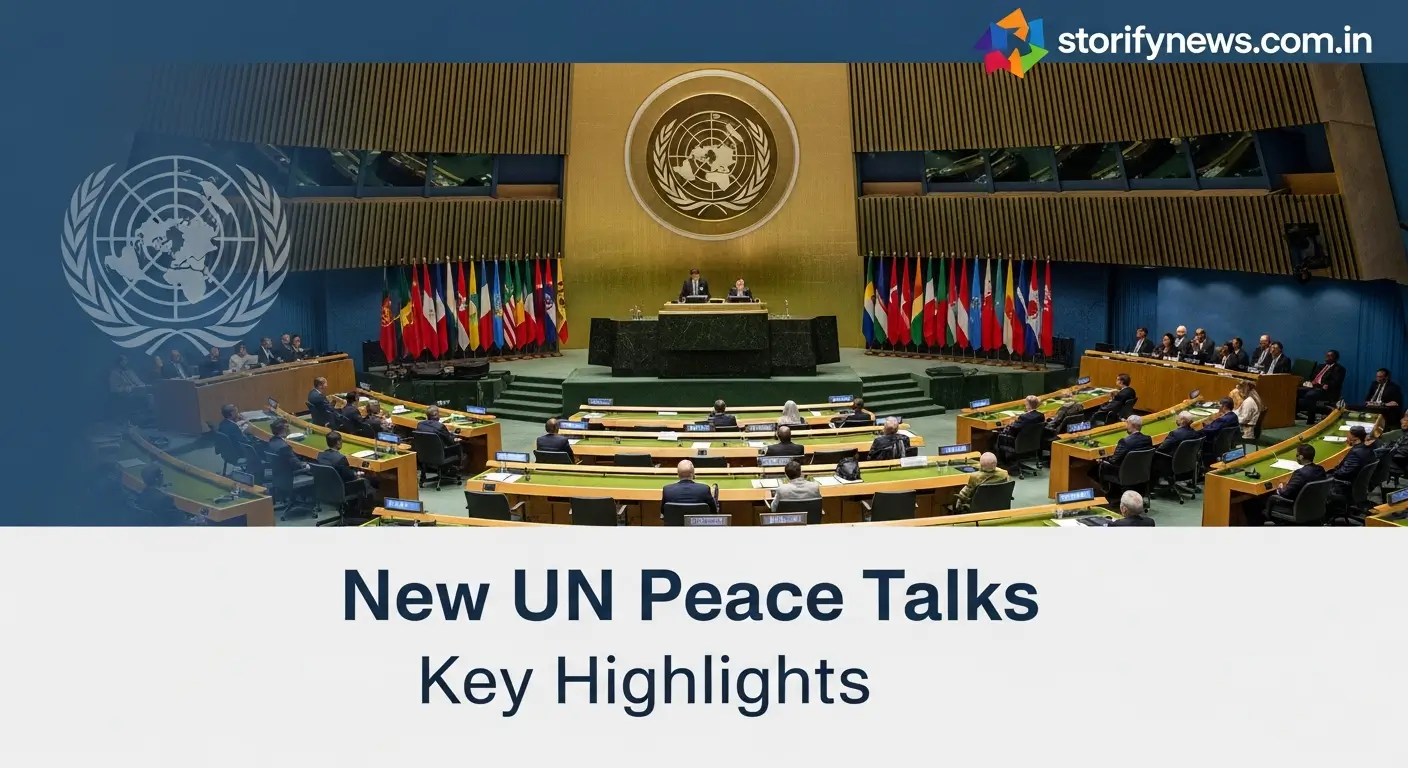
New UN peace negotiation is one of the most signaled diplomatic endeavors of recent years, at a time when the world is running higher and higher in tension with the regions spilling over the borders. The United Nations has intervened to establish a neutral ground whereby conflicting parties can meet to minimize the violence and strive to come up with a sustainable settlement. Unlike the informal diplomatic channels, UN-led negotiations possess international credibility, humanitarian control, as well as a formal framework of negotiations.
Such discussions are also linked to the plans of a humanitarian aid involving multiple countries, which implies that the development of diplomacy will have a direct impact on millions of civilians caught in conflict zones. The ongoing negotiations attracted the attention of the international community since they concern various parties – governments, military forces, humanitarian organizations, and local authorities, who could hardly find common ground in the past.
The new level of UN involvement is not only to halt fighting in the short run but to create a political channel that will lead to less conflict in the future. This fresh move is a great indicator that the UN its age old custom of being a peacemaker at a time when multilateral diplomacy is more required than ever.
Understanding UN Peace Talks – A Brief Background
The history of the way in which the previous peace processes were held should be considered to comprehend the relevance of the new UN peace talks. The UN has been a mediator of dozens of conflicts in the world- Africa, the Middle East, Asia, and Eastern Europe. In the past, certain peace negotiations of the UN had been successful because they were supported by powerful monitoring systems and international guarantees. Other negotiations, however, failed as conflicting parties were questioned on the intentions of one another or the interference of outside forces.
Modern peacebuilding has changed the strategy of peace interventions in the UN that previously centered on ceasefires. At present, the UN incorporates political stabilization, human rights enforcement, humanitarian access rules, and conflict-resolution systems into one process.
The current negotiations are based on the previous experiences in negotiations: the necessity of transparency, the avoidance of spoilers, and the localization of the ownership of the peace. The only difference this time is that the UN is employing a hybrid diplomatic policy, which is a mix of shuttle diplomacy, face-to-face treatment, and multilateral pressure to establish an atmosphere where agreements are difficult to discard.
Key Stakeholders in the New UN Peace Talks
Any peace process will be a success depending on who is at the negotiating table. The new UN peace negotiations comprise a blend of immediate warring groups, regional brokers, and global guarantors. The main belligerents are at the center, and they need to cede on how to de-escalate and subsequent administration. Besides them, some neighbors are concerned about the security and politics of their countries, whose fate is bound to it. Their collaboration may stabilize the process or contribute to the additional escalation.
The mediator is played by the United Nations envoy, and the humanitarian agencies include the UNHCR, WFP, and OCHA, which give on-the-ground evaluations of the needs of the non-government residents. Side consultations have also been considered to be inclusive and have included the civil society representatives, women’s groups, and peace activists.
This wider stakeholder model is aimed at establishing an enduring settlement, not a feeble ceasefire that will collapse as pressures dissipate. Observers of the key world powers also enhance accountability and minimize the chances of parties parting ways by parties.
Main Objectives of the New UN Peace Talks
The new UN peace negotiations have four broad goals, which are developed based on humanitarian relief, political stabilization, security assurance, and long-term peacebuilding. Achieving the first goal is to achieve a sustainable ceasefire to stop future civilian deaths and establish safe humanitarian access. No political negotiation can be successful without stability on the ground.
The second goal is political dialogue, whereby parties against each other can discuss the governance structures, the representation, the electoral process, or power sharing on a future basis. The third intention is the intention of confidence-building, which implies developing smaller, however significant measures, like prisoner exchanges or opening cut-off routes, which indicate that each party is acting in good faith.
The fourth goal is to establish the basis of reconstruction and social reintegration, since it is necessary to provide economic recovery in post-conflict areas to avoid recurrent violence. These discussions are more believable, as opposed to symbolic declarations, which are not quantifiable and whose results cannot be monitored and verified by the international community.
New UN Peace Talks | Key Highlights
There are already several highlights of the preliminary negotiations. To begin with, the willingness of all main actors to participate in the negotiations is an indication of a seldom-observed diplomatic breakthrough. In the previous efforts, one of the stakeholders declined to be part of it, thus halting the efforts.
Second, the UN has managed to establish an early humanitarian coordination framework, through which quick relief delivery to previously battalion-isolated areas can be provided. It is a big success since the humanitarian access can be the most delicate matter in the war zones. Third, there is increased agreement on the concept of a stage-by-stage roadmap rather than a one-time, grand bargain. This allows compromise to be easier and allows the negotiators to make concessions depending on the progress.
The other point of interest is the reaffirmation of the local states that they will not intervene militarily in the course of negotiations. This is a decrease of external pressure that enables negotiators to concentrate on political benefits as opposed to military gains. These early breakthroughs are positive even though a final settlement remains far away.
Core Issues Being Addressed in the Peace Talks
The peace negotiations under the new UN are addressing a multifaceted cluster of fundamental problems: security setups, political legitimacy, humanitarian accessibility, and economic stabilization. The most pressing issue is security, which both parties desire to be assured against, as disarmament or withdrawal of troops may leave them exposed. This is the reason why there is a discussion of third-party surveillance, peacekeeping control, and proposals for buffer zones. Political legitimacy is also at the center of security.
Parties have to agree on the one who is in control, the elections, and what kind of representation will be acceptable to all parties without creating another discontented situation. Humanitarian problems are also very vital. The civilians need to be assisted, secure transportation, and ensured safety of the civilians according to international law.
The displaced population will remain in distress without a respite, even when violence may temporarily reduce. Lastly, economic reconstruction and reintegration are being discussed as well-two pillars needed to achieve the sustainability of peace. No agreement will be able to endure when people do not feel evident better conditions of living. The modern process of the UN is striving to achieve a long-lasting peace, not a token one, by struggling with all these issues at once.
Implementation Mechanisms and Monitoring
Whether any UN peace initiative is going to be successful is not only determined by the outcome of the negotiation, but also by the degree to which the agreements will be put into practice on the ground. An all-inclusive monitoring framework has been offered in the new UN peace talks, which consist of on-site inspection teams, periodical reviews, and mandates of third-party observations. These are mechanisms that must be in place to achieve transparency and develop trust between the parties in conflict. The monitoring apparatus is planned to check whether there is an observance of ceasefires, whether humanitarian corridors are operating, and whether both parties are meeting the terms agreed upon.
The responsibility of the UN peacekeepers and civilian observers is another important issue where neutral intermediaries play a vital role. The United Nations can record violations and keep the actors in check by creating verification missions in sensitive areas. Electronic surveillance technologies like satellite surveillance, confidential reporting, and assessment teams are also taking a larger role in contemporary peace diplomacy.
Institutional follow-upmeasuress are also part of the peace talks, such as joint implementation committees and international oversight panels. This is because these guarantee that the political and the humanitarian aspects of the deal proceed hand in hand. Peace is nothing without action;n, consequently, these mechanisms change words into reality. Close follow-up is also important in preventing a pullback to conflict and restoring confidence among the local communities.
Challenges Facing the New UN Peace Talks
The new UN peace talks, despite the positive signs, are faced with several challenges, which can hamper progress. The greatest hurdle is the mistrust between parties. The decades of war, ceasefires violated, and promises that have not been kept formed a credibility gap. Others are afraid of the loss of political legitimacy due to political compromise, and others fear losing the territorial or military advantage.
External interference is also another significant challenge. Regional forces, proxy movements, and geopolitical coalitions may affect the peace process-in some cases favorably, but in most cases to extend the instability on strategic grounds. Competing interests in the foreign backers would decrease the leverage of the UN and stall negotiations. The international consensus will make peace talks stagnant without international consensus.
Pressure is also caused by humanitarian urgency. The success of the dialogue could be the lifeline of the millions of civilians who will rely on it to secure and gain access to aid. Nevertheless, peace diplomacy is not a fast process, whereas the humanitarian crisis is growing rapidly. It is very hard to strike a balance between long term political settlement and short term humanitarian relief. When any of these issues are not dealt with, the peace process may be derailed before permanent improvements begin to reassert themselves.
Regional and Global Impact of the UN Peace Talks
The impact of the new UN peace talks is much further than the room under the table. On a regional scale, an effective settlement would decrease cross-border armed conflicts, curb the outflow of refugees, and stabilize the trade routes and key infrastructure. The economic and security costs of a long-running conflict are usually transferred to the neighboring states, and this implies that peace would allow weaker economies to relax.
The negotiations in the world reflect a challenge of multilateral diplomacy in a world where global cooperation is tense. An epidemic would serve to reaffirm the UN as a conflict resolution platform. The mediation is also a helpful precedent in solving future conflicts, as it demonstrates that diplomacy and negotiation may be used as alternatives to military build-up.
Economic dividends could also be produced by peace. Stable areas are also likely to receive investment, and humanitarian aid will be replaced by development funds, and international organizations will be more eager to support reconstruction with money. The world will not only gain peace in one nation in the short run, but it will regain faith in the international rule-based order that forms the foundation of stability in the global economy.
What Comes Next? The Road Ahead
The second stage of the peace process will be directed at the translation of the commitments into tangible political decisions. This involves writing of final frameworks, establishing implementation boards, and that of timelines. More discussions will likely be made clear in future phases to resolve the power-sharing, security, and humanitarian access terms.
The next few months will put the strength of commitments to the test. Measures aimed at confidence-building, like ensuring that there is a prisoner exchange, demilitarized zones, and free flow of information, will also play critical roles in ensuring that momentum is maintained. Such symbolic gestures demonstrate to the people, and to the world, that there is progress going on and not only talk.
Nonetheless, the future is unstable. To be successful, one has to be patient, diplomatic, and willing to compromise. The UN will most probably increase its advisory aspect as institutions will slowly shift the responsibility to the local actors. With the parties remaining constructive in their talks, the negotiations may become the basis of a permanent deal, which not only favors political elites but also civilian populations who face the greatest impact of conflicts.
Frequently Asked Questions
What are the intentions of the new UN peace talks?
The negotiations are intended to reach a lasting truce, establish a roadway to political compromise, and permit humanitarian aid to the conflict areas.
Who is involved?
The process involves several international actors, governments in the region, UN ambassadors, and observer missions.
What is the tracking of agreements?
Verification teams, monitoring reports, satellite analysis, as well as regular diplomatic review sessions.
Can the talks fail?
Yes–in case of mistrust, negative intervention by outside operators, or party failure to deliver on the ground.
What are the positives for civilians?
A better security situation, humanitarian response, economic sustainability, and prospects of rebuilding in the longer term.
Conclusion
The latest UN peace discussions are a crucial step to renewing war with collaborations. This process is delicate and fragile, but it has remained in a position of providing hope of a political settlement with international credibility. These negotiations are a blend of humanitarian aid and foreign policy, and so peace is not only bargained–but secured.
The credibility, implementation, and subsequent regional support will help in long-term success. The UN framework offers a roadmap, and there should be a long-term commitment that is long-termcommitment by all the stakeholders. In case of further improvement, this program might become the groundbreaking case of how inclusive diplomacy may transform futures.
These peace talks are not just important to one region in the world where the conflicts are steadily becoming transboundary. They serve as a reminder that collective security, negotiation, and multilateral dialogue are still effective in creating stable societies.
